
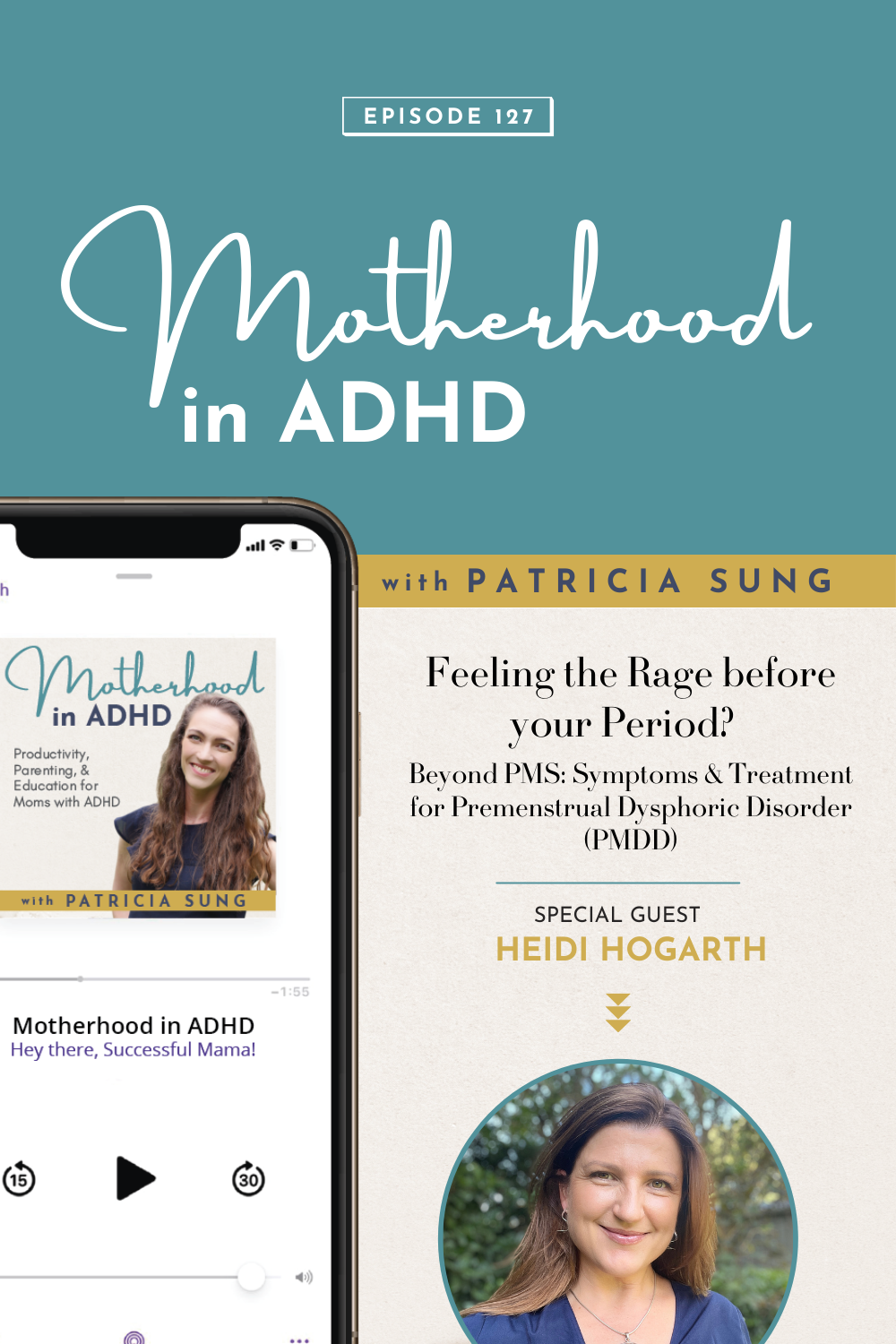
Feeling the Rage before your Period? Beyond PMS: Symptoms & Treatment for Premenstrual Dysphoric Disorder (PMDD) with Heidi Hogarth #127
When you've got PMS on steroids, the rage and depression are exponential.
Ever hear of pre-menstrual dysphoria disorder?
They call it PMDD for short, and it's a very real and serious hormonal disorder that affects up to 10% of women!
Symptoms include things mood swings (aka rage attacks), sadness, anxiety, hopelessness, depression, and even severe panic attacks.
Many women with PMDD are either extremely tired or have bouts of insomnia. And then there's excessive crying and other emotional swings. Not to mention all the bloating, gastro issues, food cravings, and possible weight gain.
Phew. I need a nap after writing that alone!
Today my guest Heidi and I unpack what PMDD is, the symptoms of PMDD, how PMDD can be linked to post-partum issues, and how to talk to your doctor about getting a diagnosis.
If you've been following along on in the last few months, we've talked a lot about menstrual health, hormones, and cycle syncing. We've uncovered numerous ways our menstrual cycle relates to ADHD symptoms in women. It's fascinating and disturbing at the same time. But there is hope, Successful Mama!
Heidi Hogarth is a naturopath, a mom of two, and a PMDD survivor. She's on a mission to support women who suffer from PMDD and help them find the best natural health tools so they can get off the hormonal emotional rollercoasters & back to their calm, positive, and loving selves.
She's a wealth of knowledge when it comes to understanding symptoms of PMDD. She offers insight into what supplements and dietary changes can help you when you feel like you are suffering from PMDD.
A big thank you to Heidi for helping women understand their bodies so they can do what they can to live a happy and healthy life.
If you are looking for more resources to help you along in your ADHD journey I would like to invite you to head to my resource page and snag some great free tools.
Go to patriciasung.com/resources. Not only will you be able to download ADHD resources on the spot, but you'll also get more ADHD mom tips right to your inbox. :)
Links to resources mentioned in this episode:
International Association of Premenstrual Disorders
Wild Power: Discover the Magic of Your Menstrual Cycle and Awaken the Feminine Path to Power Book
Cycle Synching Basics for ADHD Women: Your Hormones are Your Energy Superpower #116
Tapping (EFT) as Treatment and Self Care for Adult ADHD with Kate Moryoussef #89
Time Management Mastery opens soon! Grab a spot on the waitlist to be the first to know when you can join. Sign up here: bit.ly/adhdframework
DID YOU KNOW? There's a place where you can get your calendar and to-do list organized one step at a time, so you enjoy more time with your kids while feeling confident + capable in your day... even when your ADHD hijacks your plan. Register for Daily Planning for ADHD Moms - sign up here --> bit.ly/adhdplan
Looking for a little more added support? There’s a place for you!
Here >>> JOIN THE MOTHERHOOD IN ADHD COMMUNITY

Heidi Hogarth [00:00:00]:
And when you're in the fog of it, it's hard to imagine feeling happy before or ever feeling happy again. And then it magically lifts once you start bleeding. So a lot of these women are begging for their periods to come.
Patricia Sung [00:00:15]:
Are you overwhelmed by motherhood and barely keeping your head above water? Are you confused and frustrated by how all the other moms make it look so easy? You can't figure out how to manage the chaos in your mind, your home, or your family. I get you, mama. Parenting with ADHD is hard. Here is your permission slip to let go of the Pinterest worthy visions of organization and structure fit for everyone else. Let's do life like our brains do life. Creatively, lovingly, and with all our might. When we embrace who we are and how our brains work work, we can figure out how to live our lives successfully and in turn, lead our families.
Heidi Hogarth [00:00:58]:
Well.
Patricia Sung [00:00:58]:
At the end of the day, we just want to be good moms. But spoiler alert, you are already a great mom. ADHD does not mean you're doomed to be a hot mess, Mama. You can rewrite your story from shame spiral to success story, and I'll be right here beside you to cheer you on. Welcome to Motherhood in ADHD. Hey there, successful mama. It's your friend, Patricia Sung. Today we're chatting with Heidi Hogarth, who is an expert in premenstrual dysphoric disorder, or PMDD for short.
Patricia Sung [00:01:34]:
Heidi is a naturopath and nutritionist for women with premenstrual dysphoric disorder and severe pms. She helps women who are struggling with their premenstrual mental health get off that emotional hormonal rollercoaster, balance their bodies and minds naturally so that they can feel calm and confident not only in themselves, but in their relationships as well. As we've been diving into this discussion about hormones recently, this topic of PMDD kept coming up. This is something that so many of us are struggling with that I knew I had to find more information to share with you. Well, as we've learned, women's hormonal health is not well researched and not well documented and not really talked about. So when I came across Heidi in another group that I was working in, I was like, oh, my goodness, the.
Patricia Sung [00:02:22]:
Answer to my prayers.
Patricia Sung [00:02:23]:
Here she is, someone who truly understands what this means and how it affects us. Because as I was diving into looking into pmdd, I was heartbroken that so many women are struggling with the effects of something beyond just pms. It's not just PMS and steroids. This is a whole another beast. This is struggle on a different level. I heard the struggle in your voice, that it's beyond just having a bad day. This is a serious issue that is not being talked about. So even though Heidi is not actually very familiar with ADHD at all, in this case, it didn't matter.
Patricia Sung [00:03:03]:
What mattered is that you all need some information, and this woman has it. And as we got into our conversation, I started seeing so many parallels between how ADHD affects us and how PMDD affects. I don't think this is just a coincidence. I had so many questions for Heidi that we're going to divide this episode into two parts. Today we're talking about what is pmdd and what are the symptoms of pmdd? What should you look for if you think you might have pmdd? And also, how does it relate to postpartum? We also talked about supplements you can add and how can you talk to a doctor about getting a diagnosis and.
Patricia Sung [00:03:45]:
Feeling confident and capable when you go.
Patricia Sung [00:03:47]:
Into that doctor appointment and what to do if you get brushed off Again, another parallel of when women go in to see a doctor about adhd, a lot of times we get brushed off. Well, the same thing's happening here. So what can we do about it? PMDD is something that is affecting a large number of women with adhd. So let's get started talking about this relatively new diagnosis, but clearly not relatively new in our lives.
Patricia Sung [00:04:13]:
All right, mamas, let's welcome Heidi Hogarth with us today. How are you doing?
Heidi Hogarth [00:04:17]:
Hi. I'm great. Thank you. Thanks for having me on.
Patricia Sung [00:04:20]:
Well, I cannot wait to jump in here, because the. As we started talking about this, in my community, there were more and more women stepping forward saying that either they have PMDD or they're concerned about it. And when I found you, I was like, oh, the angels are singing. Somebody who truly understands it. And I want to shed some light on this, because I know so many women are struggling with this and don't realize that, one, they're not the only one, and two, that this is different than PMS symptoms. They're two different things. So first, if you could just tell us a little bit about how you work with women now, and then we're going to dive in and get into, what?
Heidi Hogarth [00:04:55]:
What is this? So I'm a naturopath and nutritionist, and I specialize in PMDD because like many health practitioners who specialize in things, it was a big problem for me. And there's not a lot of information and research out there, and a lot of women don't even recognize it as a disorder, and a lot of health practitioners don't recognize it as a dis. And while I was experiencing it, it was also very little known. I didn't know myself, so I managed to manage it myself. So now I work with women with PMDD as a naturopath, mainly focusing on kind of the biochemistry of mental health, or fortifying the physical body to enhance your mental health, basically using nutrition, medicine and holistic therapies.
Patricia Sung [00:05:43]:
So let's start at the beginning. What does PMDD stand for and how do you see it affect women's lives?
Heidi Hogarth [00:05:50]:
So PMDD stands for Premenstrual Dysphoric Disorder. The definition is really in the label. So dysphoria, best described as the opposite of euphoria. It's a very miserable state of existence. So PMDD differs from PMS in that it's much more severe. Some people refer to it as a PMS on steroids, but I think it kind of underestimates really what it does to people's lives. It's. People describe it as a Jekyll and Hyde kind of scenario.
Heidi Hogarth [00:06:23]:
They have a sudden switch to extreme depression, extreme anxiety, extreme rage and irritability, feelings of hopelessness and worthlessness, and it just hits quite suddenly. And when you're in the fog of it, it's hard to imagine feeling happy before or ever feeling happy again. And then it magically lifts once you start bleeding. So a lot of these women are begging for their periods to come. So the diagnostic criteria is there's a list of 10 or 15 things. It must have one of four, which are either anxiety, depression, the irritability or the sudden mood swings. So it must have that one and then five other symptoms, like could be brain fog or lack of concentration, sleep disorders, appetite changes, things like that, and they severely impact your ability to live your normal life, to work, to parent, to do whatever you have to do. So you might need to take days off work.
Heidi Hogarth [00:07:22]:
It ruins relationships. You know, it's quite often there a lot of conflict, especially in the rage and all of it. So, yeah, can people lose their jobs or lose their relationships or worry about the impact on their children? So it's quite severe, it's quite debilitating and often can last a bit longer as well than PMS. So it could be five or 10 days. So for some people who experience PMDD starts from ovulation until the bleed or even a couple of days into the bleed. So that can be two weeks, 16, 18 days of every month. Yeah. And then the other Criteria is that the symptoms resolve within a day or two of the period starting.
Heidi Hogarth [00:08:10]:
So there's definitely a week or two of feeling relatively normal, you know, Dr. Jekyll instead of Mr. Hyde.
Patricia Sung [00:08:17]:
So this part fascinates me because when I think about women getting a diagnosis of ADHD later in life, a lot of times they have had some other issues before, like anxiety and depression, because when you have adhd, you are anxious or depressed because you're struggling with all the things that encompass adhd. A lot of women will also get a bipolar diagnosis instead of the ADHD diagnosis. And it's making me, like, put all these pieces together of like, what if it's this? What if it's their premenstrual cycling in? Because that would make sense as to why they're like, okay, I felt good, this part, then I felt terrible, then I felt good, then I felt terrible. It's like, well, yeah, that does kind of sound like bipolar. But in this case, when it's linked to your cycle, it's like, oh, like, it's all coming together. I'm like, oh, mind blown. There's going to be some women listening to this, like, what on earth is going on here?
Heidi Hogarth [00:09:08]:
Yeah, it's a really common misdiagnosis, actually. People who see practitioners who aren't aware of pmdd, they're often diagnosed with bipolar and even schizophrenia. So. Yeah, and then it can go down this treatment path for sometimes years with the absolutely wrong treatment for what they're actually experiencing.
Patricia Sung [00:09:27]:
Yeah. Well, then. So that was my question. Is that are the treatments for bipolar and schizophrenia going to help these women, or is that a completely different ball game?
Heidi Hogarth [00:09:36]:
Well, I'm not a medical practitioner and I don't prescribe medications, so I can't really answer that intelligently.
Patricia Sung [00:09:45]:
Fair enough. I know someone's going to ask that. I'm like, hey, neither one of us are doctors. And I. That's one thing that I like. I'm very big of a Stigler on of like, I am not going to give you medical advice. I'll give you my opinion, but I'm not going to give you medical advice. That's not responsible of me.
Patricia Sung [00:10:02]:
So. Interesting. Okay, well, either way, I'm sure people's brains are churning. Okay, now I'm curious if, do we understand why it happens and what's occurring in the body to make us go down that path?
Heidi Hogarth [00:10:12]:
There is not enough research. It's really hard to research on a living brain, a living human brain especially. So there are theories and there are some pretty good Theories. And I guess I could say one very widely accepted theory is, firstly, it's not considered a hormone imbalance by the medical professionals. It is considered that there's an abnormal response in the brain to our natural hormone fluctuations and especially possibly in the GABA receptors. Gamma aminobutyric acid, the neurotransmitter that's good for feeling chilled out, calm, relaxed about life. It's thought that one of the metabolites of progesterone called allopregnanolone, adversely stimulates the GABA receptors. So instead of being happy and calm, it stimulates more like anxiety.
Heidi Hogarth [00:11:03]:
Anxiety and irritability and anger. I'm actually not sure how. How proven that theory is, but it's generally most widely accepted, so. But naturopathically, there are a lot of other theories or. I don't know. I'm not saying this right either, I guess.
Patricia Sung [00:11:18]:
No, I mean, I think this is one of the hardest parts, is that when I've been doing all this research about women's cycles and hormones, is that there isn't a lot of research on women's cycles, like, in general, on just, like, the base level, let alone when we start digging into these more detailed paths, because generally, SPE speaking, when they do scientific research, they pick men because they don't have cycles, and that's not going to influence the data. Like, women's cycles will change throughout that whole month. So we're a far more volatile test subject than men, who don't change much throughout the month. I feel like it's one of those medical frontiers that just hasn't really been dived into yet. Is it dove into, dive into?
Heidi Hogarth [00:11:58]:
I'm not sure.
Patricia Sung [00:11:58]:
Like, that doesn't sound right when I said it, but it really just hasn't been researched well yet. And at this point, like, this is part of why I wanted to do this podcast, is just to, like, bring awareness to it, because it's a newer diagnosis and it's not well researched, but there are still women suffering from this. And, like, when I was looking into it, it said, I think it was in the Cleveland Clinic, where up to 10% of women are struggling with this, and yet we're barely talking about it.
Heidi Hogarth [00:12:23]:
Yeah, the figures, yes, it can be up to 10%. I've had so many. But from the main organization, who is called the International association of Premenstrual Disorders, they go with the figure of 5 to 8%, but I've seen up to 12%. But worse than that is that 90% of those people who are Suffering go undiagnosed. You know, it's so common to people haven't heard of it. Often when I introduce myself as a naturopath who specializes in pmdd, I say, have you heard of that? Do you know what I'm talking about? So half the time, at least I have to explain what's PMDD before I can explain what I can do about it. Like you said, it's not a lot of research. It's getting better now and I am hearing more theories about genetic influences and naturopathically, like, it's a holistic discipline.
Heidi Hogarth [00:13:12]:
So we treat the whole person, not the disease or the set of symptoms that come in. So it kind of doesn't matter what they come to me with, you know. Yeah. So there are lots of kind of ways that I see how the physical body influences the mental health and hormonal health and all of that. I think medicine can sometimes be limited in that way, even in terms of whether it's a hormone imbalance or not. The parameters of what's normal, in terms of what your hormone level should be, are huge, really, really wide. And they don't really either. Consider the balance between progesterone and estrogen, which I think is really important.
Heidi Hogarth [00:13:53]:
It's common to see estrogen dominance and low progesterone like one or the other. So it can think, actually low progesterone is a bigger problem than high estrogen, but at least a relative estrogen dominance because the progesterone is low. So that's where the ratio comes in. So even though the bloods come back normal, you know, you see that so often, but my blood's normal. My doctor says my blood's normal and he or she doesn't have anything to offer me. Or there's the two options. It's the red pill or the blue pill, it's hormonal therapy, birth control pill or an implant or a Mirena, those kinds of things. Or it's an antidepressant most of the time, one or the other.
Patricia Sung [00:14:35]:
Like, on a personal note, I was in the last year diagnosed with mold toxicity. And it's had a huge effect on my hormone level. So I'm like, ooh, yes. Like, personally, I've been like, doing a lot of research on that. I'm like, oh, like this. It's. You're right. Medicine has.
Patricia Sung [00:14:48]:
There's a very wide value of acceptance. But what might be acceptable for one person is not acceptable for someone else. And digging into those numbers and how they relate to each other makes a huge difference when you start getting into the nitty gritty. But yeah, on the surface level, it's like, oh, you look fine. Yeah, like, well, clearly I'm not fine.
Patricia Sung [00:15:11]:
Hey mama, have you been over to my website and grabbed any of the free ADHD resources I've got? You can make your mornings more peaceful, overcome time blindness hurdles, learn ways to treat your ADHD beyond the obvious medication option, or grab a copy of all of my favorite ADHD resources on one page. You can snag these all on my website at patriciasung.com/resources and I'll email you the PDF or the video. Now don't go putting in your spammy junk email, okay? I'm not gonna send you junk. I email you once, maybe twice a week, for sure. I'll send you a note about this week's podcast topic, and if I'm having a particularly organized week, I might email you again about what's working for my ADHD this week or venting about whatever executive function disaster happened. Your inbox is where I spill more of the beans. And if you change your mind, you can always unsubscribe.
Patricia Sung [00:16:00]:
Right?
Patricia Sung [00:16:01]:
Plus, I really love hearing back from.
Patricia Sung [00:16:03]:
You, so write me an email back, tell me what's going on in your.
Patricia Sung [00:16:06]:
Life or what you want to learn about next. So go grab those free goodies and.
Patricia Sung [00:16:10]:
I'll see you in your inbox.
Patricia Sung [00:16:15]:
So when we look at the symptoms at their peak, if a woman thinks like, hey, this might be me, what are the things that would clue her in of like, can we be a little more specific? Because, like, particularly I'm thinking about the women who have mentioned that they have like suicidal ideation and there's, there's a lot more to it than just like not feeling great. Can we, like, look a little more in depth into those symptoms? That would be red flags where it's like, hey, maybe you should look into this as something that you're dealing with. What would those other things be that they should be keeping an eye out for?
Heidi Hogarth [00:16:44]:
I mean, anything that makes you feel miserable is a red flag, don't you think? Like, we're not supposed to be going through life feeling horrible, hating ourselves, self loathing, wishing we were dead, being too anxious to go out of the house or to maybe take the kids out of the house. You know, I remember postnatally, yeah, that was a big anxiety trigger for me to, oh, am I going to get all these little things together? Yeah. So anything that impacts your life and makes you feel bad about yourself, that's a red Flag. And I think it's a really subjective thing to think of. Like you can't go to a doctor and say, I've got this level of anxiety and what do you think? Do I need medication or treatment or not? It's like I feel like I'm not coping with life so I want to do something about it. Please help me. But in terms of PMDD diagnosis, it's cycle tracking is really the most important thing to do. And I believe in tracking your good times as well.
Heidi Hogarth [00:17:41]:
So there are lots of apps and forms and you can download. So whether you're into like more journaling or pen and paper or apps that will give you notifications to remind you to record your symptoms, either way is really great. And that's one of the things, if you go to see a doctor or whoever you're going to see to have at least a couple of months worth of tracking to show look at the pattern of my symptoms. That's a really key diagnostic criteria as well, that it's really happening in the premenstrual phase or the material phase of your menstrual cycle.
Patricia Sung [00:18:15]:
I think that's a really good like bar to pass of. Like, if you feel like this doesn't feel right, then speak up. That is your internal red flag. Like a lot of women who have ADHD are so used to ignoring their own internal red flags that we think that we're the ones who are in the wrong. And we, we doubt that we're truly feeling the things that we feel because our whole lives we've been told like, you're being too dramatic or you're too sensitive about that or like all these things that we've been. When we spoke up, we got this feedback of you're too much, whatever, whatever the adjective was, you're too much of what it is. So we start to doubt that. But we usually know on the inside whether or not that's right.
Patricia Sung [00:18:58]:
But we've just learned to ignore it over time.
Heidi Hogarth [00:19:01]:
Right? Yeah, you get conditioned to suppress that kind of self awareness in a way, isn't it? Yeah. And that just contributes to the whole mental health stigma as well. So I think, yeah, if you're not well, it's so easy to be honest. That sounds like a very human experience, you know, not just for people with ADHD or pmdd, but any kind of mental health issue or any issue. We don't often don't feel free to speak up and say, hey, I don't think this is okay and I need support around this. So yeah, I Think that's really common, but yeah, if you don't feel good, yeah, you need to sort it out, I guess.
Patricia Sung [00:19:45]:
Like, on that note, when we think about being willing to speak up, especially when women are dealing with these really big red flags where it's like, I'm afraid to say that I have suicidal thoughts because what if they then report me to cps? I want to take my kids. Like, we go down that anxiety, panic spiral. How do we go into an appointment with a professional and say, like, here's what I'm dealing with, and approach that conversation in a way that we would feel heard in what we're saying?
Heidi Hogarth [00:20:17]:
That can be a big problem of being dismissed by medical professionals or health professionals. I shouldn't. I'm not demonizing the medical profession. Like, I think they're amazing and we can't do without them, but it is sadly common that they do. And you have the 10 minutes to speak to their patients. Right. And not too long to go into it. And they need to know a lot of stuff about a lot of different conditions.
Heidi Hogarth [00:20:41]:
And pmdd, for example, isn't well known. So they have people who go in to their doctors and say, I'm having a big problem premenstrually and I really want to end my life or wish I wasn't here. They can be dismissed. So it's just pms. You know, everybody has this, don't worry about it here. I have the pill or whatever. So going in, you really have to be an advocate for yourself. There's some great resources on that website I mentioned before of the International association of Premenstrual Disorders.
Heidi Hogarth [00:21:13]:
So it's iam. Iap. Oh, my God. I'll let you know. You can put it in the show notes.
Patricia Sung [00:21:19]:
Yes, I'll put in the show notes. The International association of Premenstrual Disorders. Right.
Heidi Hogarth [00:21:25]:
Iapmd. I always want to say I am pmd.
Patricia Sung [00:21:29]:
We'll put in the show notes, but I'm like, there's association of Premenstrual Disorder. Who would even know? I'm like, brilliant.
Heidi Hogarth [00:21:35]:
It's a voluntary organization, but they have a huge amount of resources for anyone who suspects that they might have pmdd. Or there's another version of pmdd. It's called pme. Premenstrual Exacerbation. So that's when you might have anxiety, depression, something like that all the time, but it gets a lot worse during your premenstrual phase. So they are. Can kind of treat it a little bit differently. And that's one of the reasons that it's really good to track your cycle.
Heidi Hogarth [00:22:03]:
Anyway, on their website they have a page of resources and one of them is an appointment sheet. What to take to your doctor, what questions to ask, what to bring to show why you think you might have pmdd. So for example, you might be, might take your two or three months of cycle tracking data to show them. This is where I feel really bad. And it's, you know, this time of the month and what kind of questions you might like to ask your doctor about what treatment they're offering you, what's the evidence as to whether it's effective in pmdd, what are the side effects and that kind of thing, and whether it's appropriate for you given your unique circumstances, whether you have other health conditions, other medications, things like that. So I'd say direct your listeners there that they're really great resources to take along to your doctor. And I think if you are dismissed, if they say it's not real, I don't believe you. This isn't a problem, it's just pms.
Heidi Hogarth [00:23:03]:
It's all in your head. Please find someone else. It's not worth, you know, like it's so hard to stand up for yourself sometimes to say firstly to ask for help and then when you finally get brave enough to go to your doctor and ask for help and they dismiss you, don't leave it at that. Find a sympathetic doctor, ask on support groups for a recommendation. Actually, that same website has a provider directory of pmdd. Synthetic doctors, gynecologists, other specialists. So with PMDD it really crosses a lot of borders. So you might say we call here a gp, a general practitioner.
Heidi Hogarth [00:23:43]:
I don't know who your first line of medico is.
Patricia Sung [00:23:46]:
We use the same.
Heidi Hogarth [00:23:47]:
Okay, and then, and then from there they'll refer you. It could be an endocrinologist, could be a gynecologist, could be a psychiatrist. So it really crosses a lot of different areas of specialties. So all of those practitioners are on there as well as alternative health practitioners in that directory. I mean, but it's not exhaustive. Like I don't think I'm on there unless someone's probably there because it's all kind of patient led. So anyone who's seen a practitioner, they go onto their website and they enter that practitioner's details and say, I had a really good experience here, I'd recommend seeing them. Yeah, okay.
Patricia Sung [00:24:23]:
And then going back, you mentioned earlier about postnatally, you said there was definitely a spike in symptoms. That was one of the questions that we had from Listeners. So I asked in my Facebook community, like, what do you want to know about this? And also in my student community and both groups, people had asked about is there a connection between postpartum, given that that's obviously a big hormonal shift, do you see, like a correlation or connection between those?
Heidi Hogarth [00:24:50]:
Yeah, it's very common to emerge postpartum and in any big hormonal shift. So even a miscarriage or termination, even menopause, when everything's winding down, but there's that such huge. Can be huge fluctuations in hormones, then PMDD type symptoms can arise then, and also menarche when the periods start. So it could. I mean, for me, I'm not sure if it started, like from the first period, but maybe after a couple of years when things got a bit more regular anyway. So any time of big hormonal shift, and definitely postpartum is an area of sensitivity or time of sensitivity for women experiencing these kind of emotional hormonal roller coasters.
Patricia Sung [00:25:36]:
Is there anything that women can do knowing that that's going to be a concern? Is there anything that they could do to prepare for that? Or is it just like, good luck, we know it's coming. Hang on tight.
Heidi Hogarth [00:25:48]:
That's a good question. Whilst you're pregnant and after giving birth. Oh, gosh. A really good thing to do is to take zinc. Zinc is hugely implicated with postpartum depression and hormonal issues in general. But zinc is really sucked out of the mums by babies because it's really important in formation of protein. So, as in basically the whole baby. So making all the muscles, all the bones, all the structures of this little human that you're creating, which is an amazing thing, is sucking so much out of.
Heidi Hogarth [00:26:25]:
Out of the mum. So any nutritional fortification is really important during pregnancy. So many things, the calcium, magnesium, iron or the B vitamins, these are all the really common basic things. So seeing someone, if you think you might have a kind of sensitive mental health or hormonal health, then I would definitely be seeing a naturopath and nutritionist throughout pregnancy at least a few times to kind of keep on track and then definitely being aware that this could be a sensitive time, postpartum, to look out for those red flags, that depression that doesn't go away. You know, baby blues shouldn't really last very long, but postpartum depression can, or postpartum depletion anxiety that can actually last for years if you don't address it. Yeah, just being aware, I think, is number one.
Patricia Sung [00:27:17]:
This also, again, I'm like, fascinated because Also, people who have ADHD tend to be low in zinc, magnesium. And there was one other one. You said that iron, I think, was the other one. Yeah. So like, all of this is like coming together. I'm like, oh, there's so many connections.
Patricia Sung [00:27:31]:
All right, mama, let's pause there and be sure to hit subscribe so that the next episode pops right up on your first feed. We're going to continue talking about how do we live well with pmdd, dealing with the rage that comes along with it, and what are some recommendations for treatment? Now we also dive into the connection between gut health and brain health. We talk about gut biomes and food and supplements to eat to promote balancing.
Patricia Sung [00:27:58]:
And creating a healthy gut.
Patricia Sung [00:28:00]:
And what does that mean for us? Why does the gut matter so much when it comes to to our minds and our mental healths and our brains, we get into prebiotics, probiotics, dysbiosis, anti inflammatory diets, alcohol, poop, all kinds of digestion goodness. So meet me back here next week and let's get into the rest of our discussion with Heidi Hogarth. Let's talk then. Have an amazing week. Successful mama. For more resources, classes and community, head over over to my website, motherhoodinadhd.com.